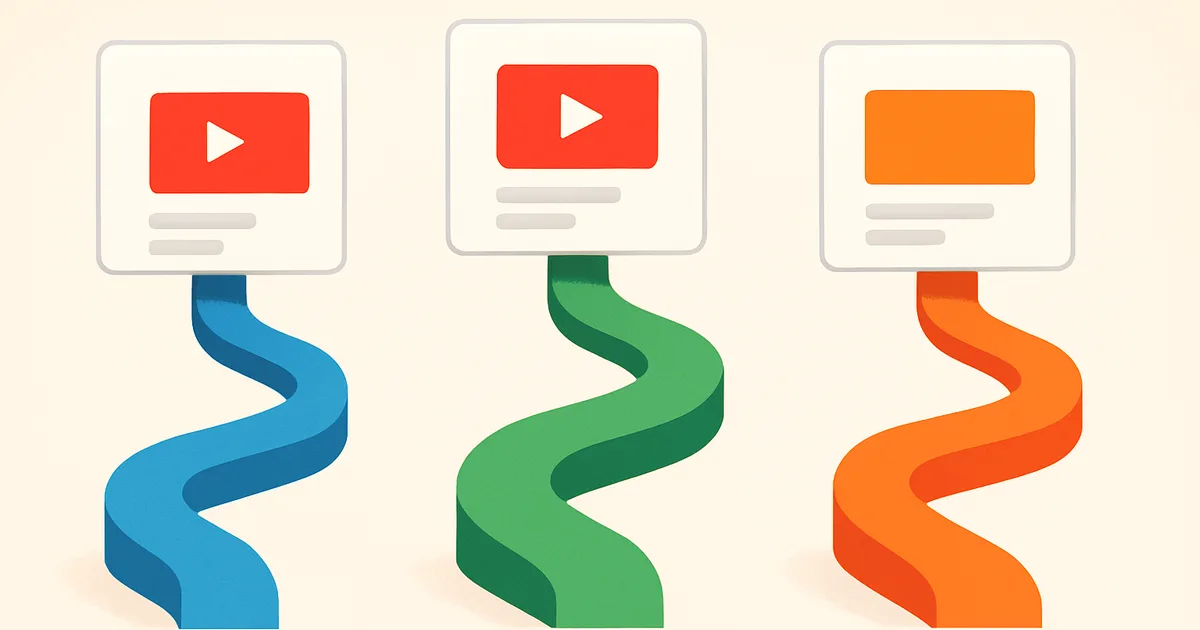
"The algorithm" is not one system. YouTube runs several, they optimise for different things, and a video can do brilliantly in one while being invisible in another. Understanding which one you are trying to win changes what you do on any given upload.
This is a practical model, not an insider account. Nobody outside YouTube has the ranking function. But the broad mechanics are documented by YouTube itself and consistent with what any channel can observe in its own analytics.
Three systems, not one
Search
Someone types a query. YouTube returns results ordered by how well each video matches that query and how likely the person is to be satisfied by it.
Relevance signals: title, description, and the spoken content (via transcription), plus tags in a minor role. Satisfaction signals: how people who clicked this result for this query behaved afterwards.
The critical detail is that search ranking is per query. A video can be first for "resolve audio drift fix" and nowhere for "resolve tutorial". They are separate races.
Home feed (Browse)
Nobody typed anything. The system picks videos it thinks a specific person will watch right now, from their subscriptions, their history, and things watched by people like them.
This is where volume lives for most channels, and search relevance plays almost no part in it. What matters is whether this viewer, at this moment, clicks and stays.
Suggested
The sidebar and the autoplay next. Driven heavily by co-watching patterns: which videos people watch in the same session as the one they are on now.
The lever here is topical adjacency. Videos that sit clearly next to an existing popular video on the same topic get suggested alongside it. This is why publishing clusters beats publishing one-offs.
Check your split before optimising anything. YouTube Studio → Analytics → Content → Traffic source types. Optimising titles for search on a channel that gets 90% of its views from Browse is solving the wrong problem.
What the systems actually weigh
Setting aside the folklore, the signals that consistently matter:
Click-through rate on impressions. Did people who were shown this choose it? This is where the title and thumbnail do their work. A low CTR means fewer impressions later — the system stops spending attention on something people skip.
Average view duration and percentage viewed. Did they stay? Percentage matters for shorter videos, absolute minutes matter for longer ones, and the system evaluates both against what is normal for videos of that length and topic — not against a universal number.
Session behaviour. Did the viewer keep watching YouTube afterwards, ideally more of your videos? A video that ends a session is worth less than one that starts a chain, which is the actual reason end screens and playlists matter.
Satisfaction signals. Likes, comments, shares, and survey responses. Individually small; collectively a check against videos that get clicks and watch time through irritation rather than value.
Query relevance. For search specifically: does the text of the video match the query, and did previous searchers for that query find this video satisfying?
Freshness — sometimes. For news and fast-moving topics, recency is weighted heavily. For evergreen tutorials it barely matters, which is why a three-year-old video can still hold first place.
Subscriber count is not a ranking factor. It correlates with ranking because channels with many subscribers usually make videos that hold attention — but the number itself is not an input. This is good news: it is why a 500-subscriber channel can outrank a large one on a specific query.
Why "watch time" is not one number
The most misleading piece of common advice is "maximise watch time", as though it were a single dial.
Consider two videos, both 10 minutes:
- Video A: 100,000 impressions, 2% CTR, 7 minutes average view duration.
- Video B: 20,000 impressions, 12% CTR, 4 minutes average view duration.
Video A has more total watch time. Video B is the healthier video: it earns its impressions, and the system will keep giving it more of them. Video A is being shown to the wrong people, most of whom skip it — and the ones who click are a self-selected minority.
The useful way to think about it: CTR decides whether you get impressions, retention decides whether you keep them. You need both, and they trade off against each other. A more sensational title raises CTR and lowers retention. The best videos raise both by being accurately described and genuinely good.
The first 30 seconds
Retention curves have the same shape across almost every channel: a steep drop in the first 30 seconds, then a gentler slope.
That first drop is the single most improvable thing on most channels, and it is almost always caused by the same mistakes:
- An intro animation before any content.
- Explaining what the video will cover instead of covering it.
- A greeting and a subscribe request before there is a reason to subscribe.
- The promise from the title not being visible yet.
The fix is unglamorous: start with the payoff, or with the specific problem the viewer arrived with. If the title says you will fix audio drift, show drifting audio in the first ten seconds.
What this means in practice
Publish in clusters. Three to six videos on adjacent queries beat six unrelated videos. It gives Suggested somewhere to put you and gives search a reason to treat your channel as being about the topic. See the keyword research workflow for building these.
Target queries you can win. Ranking first for a small query beats ranking fortieth for a big one, and it accumulates. Small wins teach the system what your channel is for.
Fix the first 30 seconds before anything else. More leverage than any metadata change.
Change one variable at a time. Retitling and re-thumbnailing simultaneously tells you nothing. Change one, wait two weeks, read the CTR.
Measure position, not vibes. Studio does not report where you rank for a given query. Check it directly with the rank tracker at one week, one month, and three months.
Do not chase freshness on evergreen topics. A tutorial published today competes with a tutorial from 2023 that has three years of satisfaction data. You beat it by being better and clearer, not by being newer.
Things that do not work
Worth stating plainly, because they persist:
- Buying views. The traffic does not retain, which is a strong negative signal.
- Tag stuffing. See tags versus hashtags for what tags actually do.
- Keyword-dense descriptions. Repetition is not a multiplier.
- Engagement bait ("comment 1 or 2!"). Comments are a weak signal and manufactured ones are recognisable.
- Reuploading a video that underperformed. Same video, no new information, and now the old one competes with it.
The short version
- Search, Home, and Suggested are three systems with different rules — know which one you are playing.
- CTR earns impressions; retention keeps them. Both, together.
- Watch time is not a single number to maximise; a smaller, better-targeted audience beats a larger indifferent one.
- The first 30 seconds is the highest-leverage part of any video.
- Publish clusters, target winnable queries, change one variable at a time, and measure position directly.